Inglewood and nearby South Bay and South LA communities
Plumber in Inglewood, CA
Leak, clog, no hot water or a sewer backup? Call or send a request to be connected with an independent Inglewood plumbing contractor.
Plumbing problems in Inglewood rarely wait for a good time. A galvanized supply line in a 1940s bungalow finally gives out inside a wall. The water heater in the garage or the hall closet starts leaking from the bottom. The kitchen drain backs up the night before a family gathering, or the tub gurgles every time someone flushes. Some of these are emergencies and some can wait a day, but each one raises the same questions: who should I call, and what is this going to cost?
Inglewood Plumber Help keeps the first step simple. Call or send a request, and it goes to an independent plumbing contractor who serves Inglewood and the surrounding communities. The plumber contacts you, looks at the problem and gives you a price before any work begins. You decide whether to go ahead, and there is no charge for the referral.
Requests are welcome from Morningside Park, Fairview Heights, Century Heights, North Inglewood, Lockhaven and every other part of the city, from homes inside city limits and homes in the unincorporated county pockets next door, and from El Segundo, Hawthorne, Lennox, Ladera Heights and Westmont. Single-family homes, duplexes and apartment buildings all start the same way: one call or one form.
Inglewood Plumber Help is an independent referral service, not a plumbing company. It does not employ plumbers, own trucks or sell water heaters. When you call or send a request, it is passed to an independent, third-party plumbing contractor who serves Inglewood. That contractor contacts you, looks at the problem, sets the price, schedules the work, handles any permit and backs the job with their own warranty and terms.
Using this site costs you nothing. You pay only the plumber, and only if you approve the work they quote. Callbacks and on-site availability vary.
More about us
Most Inglewood plumbing calls come down to five kinds of work: urgent problems that cannot wait, clogged drains, water heaters, the sewer lateral that runs from the building to the street, and leaks you can see or only suspect. Each service page below covers the warning signs, how the work is usually done in plain terms, typical costs with their sources, the California and local rules that apply and the questions worth asking before you agree to a price.
Requests are welcome from across Inglewood and from nearby communities in the South Bay and South LA. El Segundo, Hawthorne, Lennox, Ladera Heights and Westmont each have their own page covering the water, sewer, housing and permit details that set them apart. Requests from Lawndale, View Park-Windsor Hills, Westchester, Del Aire and West Athens are handled the same way. Coverage is always confirmed by address when the plumber follows up.
See all service areas
Your request goes to an independent plumbing contractor who works in Inglewood and nearby communities.
Ask for the price, or at least the service call fee and hourly rate, before anyone starts.
California licenses plumbing contractors through the CSLB, and you can look up any license online.
Using this site is free. You pay the plumber only for work you approve.
The plumber you are connected with sets their own prices, so every figure here is a guide, not a quote. "Plumbing" covers everything from a dripping faucet to a new sewer lateral, so prices spread wide. Read these as several sources side by side, not one true Inglewood price.
Los Angeles figures (Angi; the pages do not date their data; read November 2026):
Figures not tied to Los Angeles: HomeGuide's emergency plumber guide (undated) puts after-hours weekday rates at $120 to $300 an hour, weekends at $150 to $350 and holidays at $200 to $450 or more. HomeAdvisor's clogged drain guide (labeled 2025, national) puts most drain clearing at $147 to $345. HomeAdvisor and Angi share one cost database, so count them as one source. Each service page lists the figures for that kind of work.
What moves the price: when the work happens, how hard the pipe is to reach (behind plaster, under a slab, no cleanout), the pipe material, how long and deep any sewer work runs, trenchless lining versus an open trench, tank versus tankless and gas versus electric, earthquake strapping and connector upgrades, and permit fees. Ask for the price, or the service call fee and hourly rate, in writing before work starts.
Not every Inglewood address gets water from the same place, and it matters when you need to report a leak in the street or read a water quality report.
Your water bill shows which one serves you. A break in a water main in the street is the water provider's job, not a plumber's, so call the provider named on your bill. If the leak is on your side, in the yard or inside the house, that is plumbing work. California's C-36 plumbing license covers water piping "from the owner's side of the meter to the building," per the CSLB.
Every water source serving the Inglewood area is hard, which means minerals that leave scale in water heaters, faucet aerators, showerheads and tankless heat exchangers over time.
What it means in practice: a tank water heater collects sediment in the bottom, which can cause rumbling and shorten its life, and a tankless unit can scale up inside. Ask the plumber whether periodic flushing or descaling makes sense for your heater, and whether a water softener or conditioner is worth considering. Water conditioning equipment is part of the C-36 plumbing license scope, according to the CSLB.
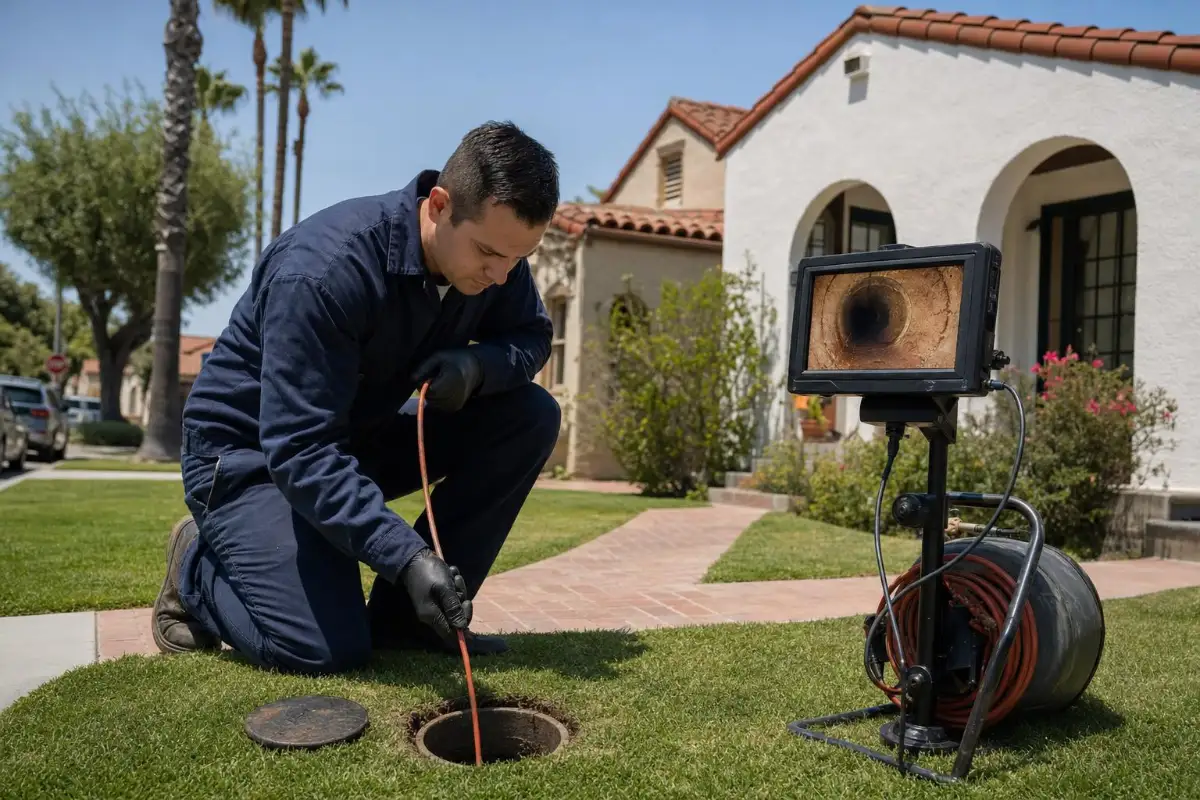
Three layers of pipe carry wastewater away from an Inglewood home, and each has a different owner.
Inglewood's own grease ordinance (Municipal Code Ch. 10, Art. 17) defines a sewer lateral as "the wastewater connection between the building's wastewater facilities and a public sewer system." If you are not sure whether a backup is in your lateral or the public main, a plumber's camera is how you find out.
Plumbing advice written for cold places does not fit here. NOAA's 1991 to 2020 normals for nearby LAX, which is next to Inglewood but not in it, show coldest average lows of 49.1 degrees in December and 49.4 in January, average highs near 77 degrees in August and September, and an average of zero nights a year at or below freezing. Rain falls mostly in winter: about 2.9 inches in January, 3.0 in February, 2.2 in December and under an eighth of an inch a month from June through September, or about 12.2 inches a year by our sum.
So when a pipe bursts in Inglewood, cold is rarely the reason. Age, corrosion, water pressure, hard water scale, a failed fitting or an earthquake are the usual suspects. The winter rain months are when a cracked or root-filled sewer lateral is most likely to show itself, and the long dry season is when tree roots go looking for moisture in old sewer joints.
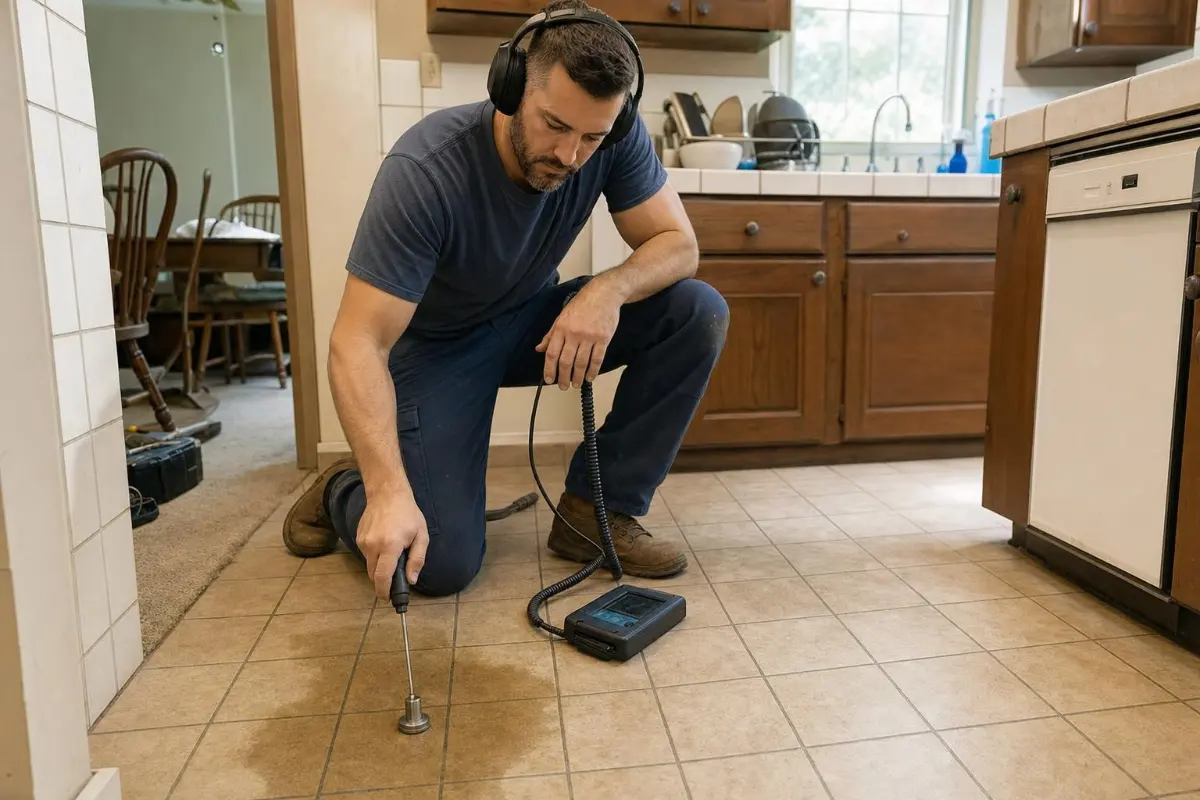
Inglewood's housing is old by Southern California standards. The Southern California Association of Governments' housing data for Inglewood (April 2021, from the 2014 to 2018 American Community Survey) shows homes by year built:
By our math from that table, about 54 percent of Inglewood homes were built before 1960 and about 81 percent before 1980, compared with about 32 percent before 1960 across the SCAG region. Census Reporter, summarizing the 2024 American Community Survey, counts 102,765 residents in 44,315 housing units, with a median owner home value of $798,300.
What that means for pipes, as general plumbing knowledge rather than an Inglewood count: homes from that era were often built with galvanized steel supply pipe and cast iron drains, both of which corrode and narrow from the inside over the decades, and older sewer laterals tend to have more joints for roots to find. Signs of tired supply pipe include low pressure at several fixtures, rusty water, repeated pinhole leaks and fittings that weep. When leaks keep showing up in the same kind of pipe, ask the plumber whether repiping a section or the whole house makes more sense than another spot repair. Replacing concealed pipe is permit work, so ask who will pull the permit.
California's State Water Resources Control Board launched a statewide service line inventory in February 2026. It reports "no lead reported in nearly 10 million service connections" across the state, with about 600,000 lines, roughly 6 percent, still of unknown material. The release links a public lookup map where you can check your address.
The inventory covers service lines, not the pipes, solder and fixtures inside your home. The Water Board suggests checking fixtures and interior piping, especially anything installed before 2010. Golden State Water's Southwest system report shows lead at the 90th percentile as not detected in its 2023 sampling, with 1 of 107 samples over the action level, and copper at the 90th percentile of 0.12 milligrams per liter. Golden State Water also says its Southwest system has no lead or galvanized service lines that need replacing, customer-owned lines included. If you have questions about older faucets or interior pipe, a plumber can look at what is in the walls and under the sinks.
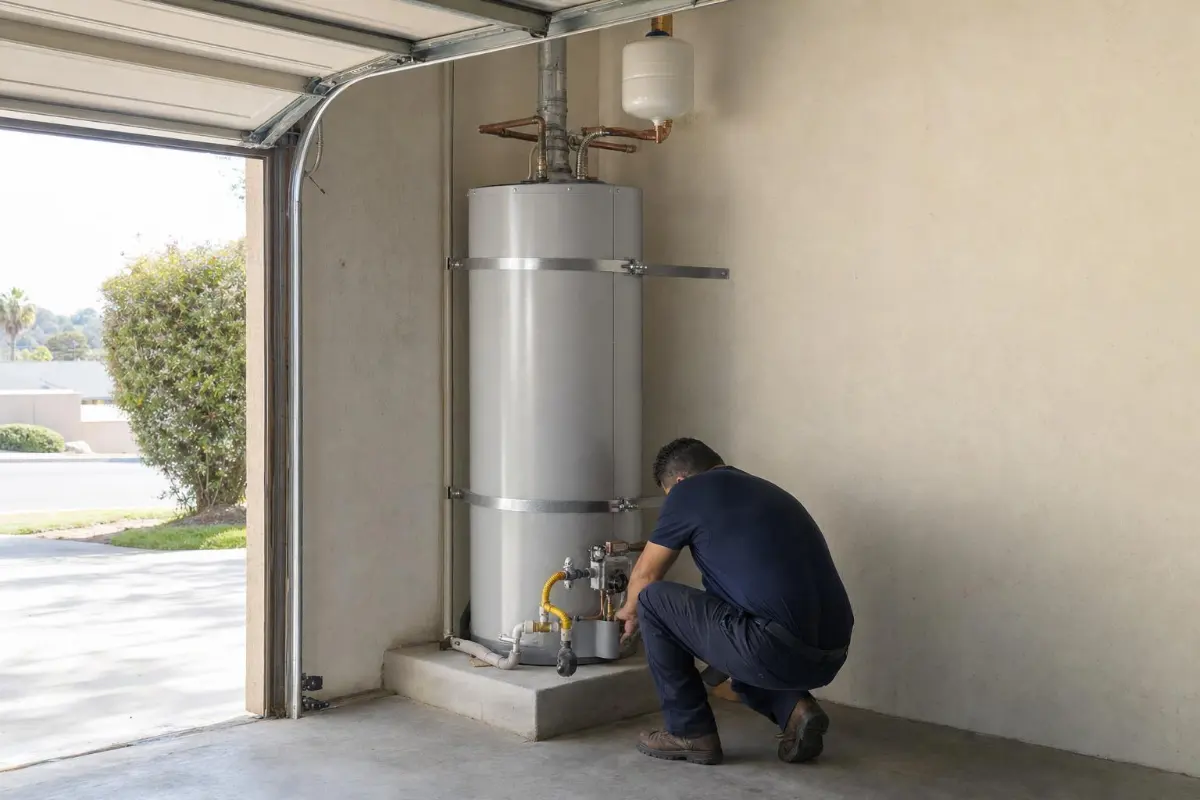
California law requires every residential water heater to be secured against earthquakes. Health and Safety Code 19211 (unofficial reprint) says "all new and replacement water heaters, and all existing residential water heaters, shall be braced, anchored, or strapped" against falling or sideways movement, installed at least to the California Plumbing Code. It applies to heaters up to 120 gallons, and home sellers must certify compliance to buyers in writing.
The Division of the State Architect's strapping guidelines explain what that looks like:
SoCalGas gives the same two-point advice, upper third and lower third, with the lower strap "at least four inches above the thermostat controls," and says to replace semi-rigid aluminum or copper gas appliance connectors with approved flexible ones. The Earthquake Country Alliance adds that the tank should sit no more than two inches from the wall, with a wood block fastened to the studs if the gap is wider. If your heater is not strapped, a plumber can add straps on a service visit, and any new heater should be strapped as part of the install.
An Inglewood-area address does not always mean the City of Inglewood. Some homes with an Inglewood mailing address are in unincorporated LA County, for example Lennox, Ladera Heights or Westmont, where LA County issues permits.
Inside city limits. City of Inglewood Building and Safety, at 1 Manchester Blvd., issues plumbing permits "for any contracted work done within city limits," according to 211LA's listing of the city office. Inglewood follows the California Plumbing Code with local amendments, and permit fees are set by City Council resolution, per the city code. Water heater replacement normally needs a permit; a licensed plumber pulls it.
Unincorporated county areas. LA County Public Works Building and Safety gives "replacement of a residential water heater. No plan check required" as its example of a permit issued once the application is complete and the fee paid. Applications, fees and inspection requests go through EPIC-LA, the county's online portal for unincorporated areas, and owners of a one- or two-family home may pull permits for their own principal residence if the work is not meant for sale within a year. The county's permit FAQ says gas piping needs a plumbing permit, even inside an accessory building that is otherwise exempt. County building and safety fees rose 3.4 percent on July 1, 2026, per Public Works.
Ask the plumber whether your job needs a permit and who will pull it, and check that the final inspection passed before you make the last payment.
California licenses plumbing contractors through the Contractors State License Board. The C-36 Plumbing Contractor class covers systems that provide "a supply of safe water, ample in volume and of suitable temperature" and the "proper disposal of fluid waste," including gas piping and venting, gas appliances and flues, water and gas piping from the owner's side of the meter to the building, water heating equipment, and devices such as "gas earthquake valves," "back flow preventers" and water conditioning equipment.
The $1,000 rule. Since January 1, 2025, someone without a license may take on a job only if the total is under $1,000, raised from $500 by AB 2622, according to the CSLB's announcement. That limit "includes all costs associated with the project," it applies only when the job needs no building permit and the unlicensed person hires no workers, and unlicensed ads must say the person is not licensed. A water heater replacement needs a permit, so it falls outside the exemption at any price.
Down payments. The CSLB's consumer guide, What You Should Know Before You Hire a Contractor, says to "Pay no more than 10% down or $1,000, whichever is less." It also says to check that a license is current and in good standing, which you can do with the CSLB's Check A License search. Ask for the license number, then look it up.
Inglewood is a city of renters. SCAG's housing data shows 64.4 percent of households rent and 35.6 percent own, compared with 52.5 percent owners across the region. By housing type (California Department of Finance, 2020), 38.1 percent of homes are single-family detached, 6.0 percent attached, 14.3 percent in buildings of 2 to 4 units and 41.1 percent in buildings of 5 or more.
That shapes how plumbing problems get solved. In an apartment, one kitchen stack or sewer lateral can serve several units, so a clog or leak in one unit may start somewhere else. If you rent, tell your landlord or property manager first, since they usually arrange the repair and choose the plumber; check your lease. If you own or manage a duplex, fourplex or larger building, requests are welcome for common lines, water heaters serving several units, laterals and leaks between floors. Say how many units are affected when you call or send a request.
Whether you use this site or call around yourself, these questions sort plumbers quickly.
Keep the down payment to no more than 10 percent or $1,000, whichever is less, as the CSLB advises.
Inglewood Plumber Help cannot help with a gas leak, and neither should any plumber you call first. SoCalGas, the gas utility, gives these steps for a suspected leak:
SoCalGas also says not to turn off your meter unless you smell gas, hear it escaping or see other signs of a leak, and only if it is safe. If you do shut it off, leave it off and have SoCalGas turn it back on and relight the pilots. The same rule holds after an earthquake: shut the gas off only on signs of a leak, and only SoCalGas field staff may turn it back on at the meter. Once the utility or the fire department has made the house safe, a licensed plumber can repair gas piping to an appliance, which needs a permit.
Sewer lateral and water line replacements often mean digging in the yard or the parkway. SoCalGas's safety insert says to contact 811 at least two business days before digging, not counting the day you call, and to wait for utilities to mark their lines. Use hand tools only within 24 inches of a marked line, and know that a ticket is valid for 28 days. On a sewer or water line job, ask the plumber who is calling 811 and when the marks will be in place.
1. Call or send the form. Describe the problem, how urgent it is and where you are. 2. A plumber follows up. An independent plumbing contractor who serves Inglewood contacts you to set a time. Callbacks and on-site availability vary. 3. Diagnosis. The plumber looks at the problem and explains the cause. Ask up front about any service call or diagnostic fee. 4. Written price. You get a price for the repair before work starts. For bigger jobs, ask what is included and what could change it. 5. Permit and repair. If the work needs a permit, the plumber pulls it and does the work. 6. Inspection and final payment. Where a permit was pulled, check that the final inspection passed before paying in full.
You decide at every step. Nothing is done without your approval, and there is no charge for the referral.
Requests are welcome from every part of Inglewood, including:
Across the city, about 54 percent of homes were built before 1960, by our math from SCAG's housing data, so many supply lines, water heaters and sewer laterals have some age on them. Requests are also welcome from every other Inglewood neighborhood. Mention your neighborhood, cross streets or ZIP code when you call or send a request.
The same referral process covers homes outside city limits:
Permit rules differ by city and county, so the plumber confirms which office applies when they follow up. Coverage is confirmed by address.
Inglewood Plumber Help does not handle insurance claims and cannot tell you what your policy covers. Sewer backups, slab leaks and slow leaks are each treated differently by different policies, and a renter's policy and the building owner's policy cover different things. Read your policy and call your agent or insurer before you assume either way. Take dated photos of any damage, keep receipts and save the plumber's written description of the cause. If you are selling a home, remember that California requires sellers to certify in writing that the water heater is strapped.
Inglewood Plumber Help does not do the plumber work itself. When you call or send the form, we pass your request to an independent local contractor who covers your part of Los Angeles County. That contractor contacts you, gives you the estimate and does the work.
See what happens after you callNo. Inglewood Plumber Help is an independent referral service, not a plumbing company. Your request goes to an independent plumbing contractor who serves Inglewood. That plumber looks at the problem, sets the price, does the work and provides any warranty under their own terms.
No. The referral is free. You pay only the plumber, and only for work you approve after hearing the price.
It depends on the job and the time of day. Angi's Los Angeles page (undated) puts a typical plumber visit at $193 to $600, with a service call or diagnostic fee of $100 to $250 and after-hours work at 1.5 to 2 times the standard rate. The plumber sets the price.
It depends on the plumber's schedule. Callbacks and on-site availability vary. Say clearly whether water is running, the sewer is backing up or you have no hot water, so the plumber knows how urgent it is.
In unincorporated LA County areas such as Lennox, Ladera Heights and Westmont, LA County Public Works says laterals are entirely owned by the property owner, including the part under the street. Inside Inglewood, check with the city for your address; across most of the LA area, the homeowner owns the lateral to the main.
Leave the building, get everyone out, do not touch light switches, and call SoCalGas or 911 from outside, as SoCalGas's safety guidance says. Do not call this site or a plumber first.
Tell us what is going on with your plumbing and get connected with an independent Inglewood plumbing contractor.
Free — no obligations